
Sewer project designed to protect Lake St. Clair’s water quality
Posted on September 11, 2025
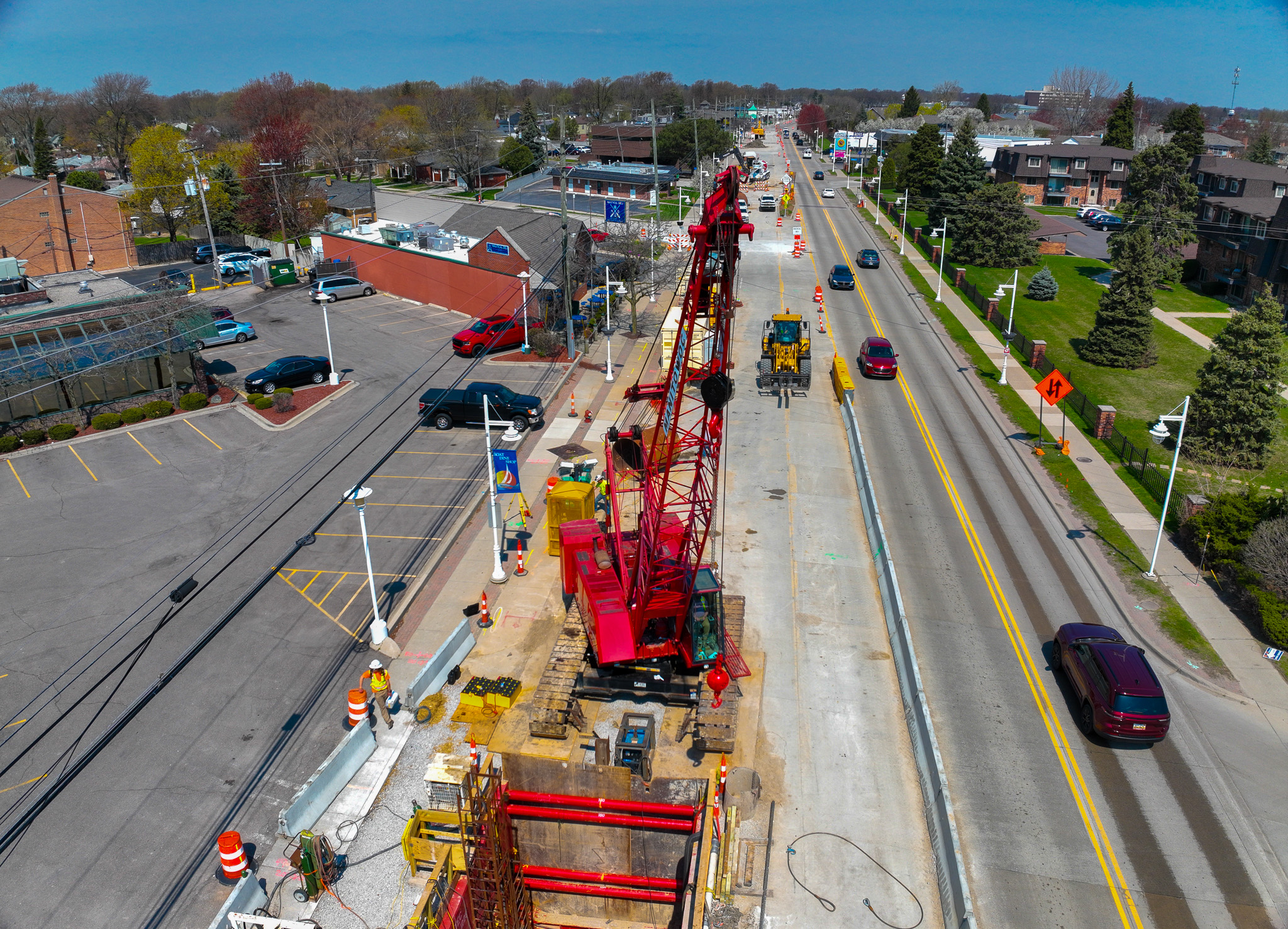
A new sewer pipe is under construction along Jefferson Avenue in St. Clair Shores as a way to manage the flow of wastewater while keeping pollution out of nearby Lake St. Clair.
Work on the Jefferson Relief Sewer project began in February 2025 after initiation from the Southeast Macomb Sanitary District and the Macomb County Public Works Office. The design and construction team is a cooperative effort between Anderson, Eckstein & Westrick, Inc.; other engineering firms Fishbeck and NTH; and contractor Ric-Man Construction. The $25.7 million project has received over $30 million in federal, state, and county funds.
Currently, two retention treatment basins (RTBs) exist along Jefferson Avenue in St. Clair Shores’ Nautical Mile district: the Martin RTB and the Chapaton RTB. These basins hold large amounts of combined sewage from Eastpointe, Roseville, and St. Clair Shores following large rains.
The existing sewer system currently uses a 60-inch-diameter Jefferson Interceptor sewer to help balance and manage the flow between the two retention basins. But often that pipe isn’t large enough to handle the volume of flow generated by large rains. When the system’s design flow is exceeded, a combined sewer discharge can drain into Lake St. Clair.
“If a storm starts to become too much for the pipes, it starts to fill up that basin, and once the basin is full, it starts to go over a weir into the lake,” AEW Executive Vice President Scott Lockwood, PE, explained.
“(The discharge) is dosed with chlorine for disinfection and pumped into Lake St. Clair. And so, that’s obviously not very desirable.”
To reduce the volume and frequency of discharge, the Jefferson Relief Sewer project is installing an additional, parallel 60-inch-diameter sewer from Nine Mile Road to Rio Vista Road. That additional pipe is necessary for the basins to cooperate and handle additional flow so that the water can flow downstream to the Great Lakes Water Authority’s Water Resource Recovery Facility (WRRF) as intended.
In order to get that additional pipe into the ground, it requires heavy machinery and engineering expertise. To minimize disturbance, a tunnel-boring machine is being used to burrow an underground path for installing new pipe segments along Jefferson Avenue.
Work has quickly progressed on the new sewer. Between May 5 and July 29, an estimated 1,160 feet of pipe was installed.
But the project has its challenges. For instance, the newly installed pipe must cross sanitary sewers from 19 side streets. In addition, the sewer path beneath the Nautical Mile’s road curves, but the tunneling machine only bores the earth in a straight direction.
To circumvent this, the project redirects the tunneling machine at several points along Jefferson. The project has been designed in phases to allow for tunneling several straight segments, thus preventing the entire road from being torn up at once and minimizing disruptions to businesses, residences, and marinas in the bustling coastal corridor.
The project will reduce the volume and frequency of combined sewer discharges into Lake St. Clair, which is applauded by community leaders as a way to improve the local environment and water quality.
For Macomb County Public Works Commissioner Candice S. Miller, the project serves her mission to clean up Lake St. Clair as much as she can.
“It will have a significant impact because we estimate it will reduce combined sewer overflows from the Martin Retention Treatment Basin by 60%, thereby improving water quality in our magnificent Great Lakes,” Miller said.
Director Kip C. Walby of the Southeast Macomb Sanitary District is in full support of this project.
“Our mission at the SEMSD is to keep water out of basements, which is closely followed by keeping combined sewer overflows out of Lake St. Clair. This new sewer pipe will allow us to have better control of the system, which will reduce the volume and frequency of discharges to the lake,” Walby said.
The sewer construction along with the reconstruction of Jefferson Avenue is expected to wrap up around November 2027.